
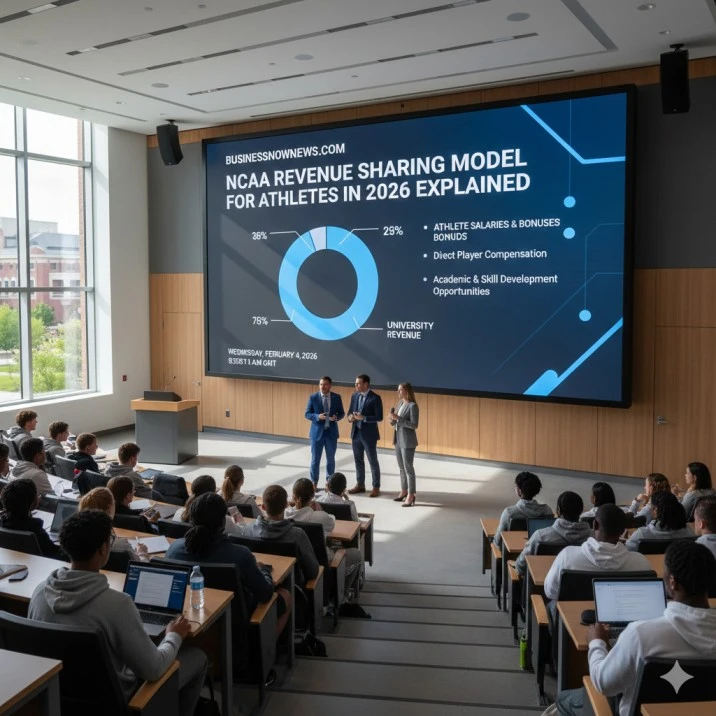
If you’ve followed college sports for any length of time, you know this moment has been coming. Quietly at first. Then all at once.
By 2026, the NCAA won’t just be talking about fairness or “student-athlete welfare.” Real money will move directly from athletic departments to players. Not NIL collectives. Not boosters. Actual revenue sharing.
I’ve covered college football and basketball long enough to remember when free tattoos were a scandal. So yes, this shift feels wild. But it also feels inevitable.
Let’s break down how will revenue sharing work in NCAA, what the 2026 demonstrate truly looks like, and why it’s approximately to alter selecting, lists, and control flow more than NIL ever did.
NIL cracked the door open. Revenue sharing is kicking it down. NIL let athletes earn money from endorsements. But schools still kept the real cash. Media rights. Ticket sales. Conference payouts. Playoff money.
Read Also: Master of Science in Sports Management Online: What You Know?
That gap created tension fast. I spoke with a Power Five compliance officer last fall who said, “We’re pretending NIL fixed everything. It didn’t. It just exposed the imbalance.”
Claims, open weight, and settlement talks constrained the NCAA to confront reality. By 2026, a few frame of coordinate income sharing gets to be unavoidable.
At its core, the NCAA revenue sharing model means schools will directly pay athletes a share of the money their sports generate. Not all revenue. Not every athlete equally. And not across every division.
Think of it more like a pro-style pool system, adapted (messily) for college sports. The early framework looks like this:
Schools allocate a set percentage of athletic revenue
That money goes into an athlete compensation pool
Distribution varies by sport, role, and market value
NIL still exists on top of this
This isn’t a salary cap league. It’s closer to controlled chaos.
Here’s what people actually want to know.
Each participating school sets aside a percentage of eligible revenue. Media deals and postseason payouts matter most here.
Big TV schools have a huge edge. That won’t change.
Players receive payments straight from the school, not through collectives or boosters. That matters legally and culturally.
This is the biggest psychological shift.
Let’s be real. These sports drive the money.
Revenue sharing won’t look equal across all sports. Olympic sports benefit indirectly, but football rosters will see the largest checks.
Revenue sharing doesn’t kill NIL. It stabilizes it. Endorsements still exist. Collectives still operate. But the desperation money slows down.
This is where fans underestimate the scale. Top athletic departments bring in $150–200 million annually. If even 20% goes to athletes, that’s $30–40 million per school.
You Must Also Like: Can You Make Your Own Business As A Sports Coach?
Spread that across football, basketball, and others, and suddenly roster spots carry real financial weight. I’ve heard estimates from insiders that starting quarterbacks at top programs could see six figures annually from revenue sharing alone. Before NIL money. Before endorsements.
Here’s where it gets interesting.
Right now, the highest NIL schools dominate recruiting because boosters spend aggressively. Think Texas, Alabama, Ohio State, Georgia, Oregon.
Revenue sharing narrows that gap slightly.
Why? Because it ties money to actual institutional revenue, not donor enthusiasm.
A mid-tier school with a massive TV payout suddenly becomes competitive again.
I don’t expect Texas to fall off. But I do expect fewer wild NIL bidding wars.
This question comes up constantly.
There’s no official ledger, but based on reporting, recruiting results, and collective disclosures, programs like Texas, Texas A&M (early on), Miami, and Oregon have been near the top.
One SEC staffer told me off-record, “We lost a kid to an NIL deal that paid more than our assistant coaches.”
Revenue sharing makes that less common. Schools regain some control.
Recruiting changes fast in 2026. Instead of vague NIL promises, schools will show:
Guaranteed revenue-sharing payouts
Structured compensation plans
Transparent earning potential
That clarity matters to families.
Parents trust predictable money more than booster whispers. Expect official visits to feel more like job interviews. Because they kind of are.
Some programs benefit immediately.
Schools with strong conference deals win. The SEC and Big Ten stay on top.
Well-run programs adapt faster. Chaos-heavy schools struggle.
Revenue sharing creates room for smarter allocations beyond just star quarterbacks.
Let’s not sugarcoat it.
If you don’t generate revenue, you can’t share much. That gap widens.
Some collectives burn out once schools pay players directly.
Revenue sharing exposes real roster value. Not everyone likes that.
This is the question administrators hate.
Officially? No.
Functionally? Kind of.
Revenue sharing blurs the line. Contracts, expectations, performance-based decisions all follow. One veteran coach told me, “Once checks come from the school, culture changes. You better be ready.”
He’s right.
If you’re a recruit or transfer, here’s the advice I give everyone.
Ask about revenue-sharing structure, not just NIL
Look at conference stability
Ask who controls payments and how disputes work
Think long-term, not just Year One money
The biggest mistakes will come from chasing short-term cash without stability.
A few myths need killing.
Players won’t get rich overnight
Walk-ons won’t all get paid
Ticket prices won’t skyrocket immediately
Rivalries won’t disappear
College sports will still feel like college sports. Just more honest.
Here’s the quiet shift. Revenue sharing forces schools to admit athletes create value. Not “opportunity.” Not “exposure.” Value.
Once that truth settles in, the system never goes back. I’ve watched college sports evolve for over a decade. This is the biggest change yet. Bigger than NIL. Bigger than conference realignment.
And honestly? It was overdue.
The NCAA revenue sharing model for athletes 2026 won’t be perfect. It will be messy. Some schools will screw it up. But it brings structure to chaos.
It answers the core question fans keep asking: how will revenue sharing work in NCAA sports without destroying them? Slowly. Unevenly. But forward.
If you care about recruiting, NIL trends, or where college football is headed, this is the shift to watch. Everything else is noise. If you want, I can also break down:
Which programs are best positioned under revenue sharing
How this affects transfers and roster limits
What athletes should ask on visits in 2026
Just tell me where you want to go next.