
You have probably used ChatGPT to draft an email. Maybe you have asked Copilot to summarize a meeting.
That is not what I am talking about.
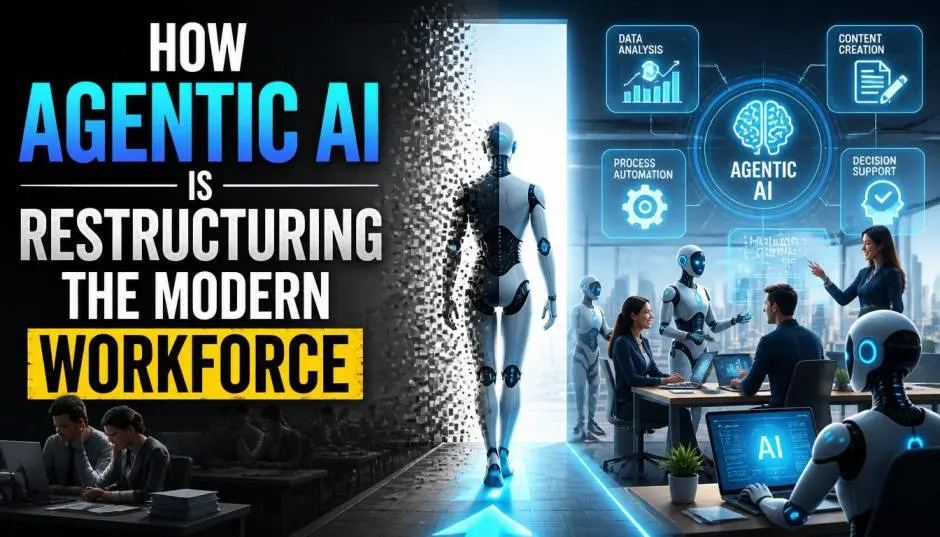
Agentic AI in the workplace is different. It does not answer questions. It takes action.
Imagine an AI that does not just tell you a customer refund policy. It processes the refund. Updates the CRM. Sends the confirmation email. Logs the ticket. All without you lifting a finger.
This shift from "chatbots that talk" to "agents that do" is the biggest change to knowledge work since the internet.
I have spent the last eighteen months tracking real deployments at companies like AT&T, Aon, and PwC. The results are impressive. The problems are real. Let me walk you through exactly what is happening, where the risks hide, and how to prepare.

Here is the shortest definition you will find.
A chatbot generates text. An agentic AI achieves goals.
Read Also: What Is the Difference Between Economy and Premium Economy?
Take customer support. A chatbot tells you your refund status. An agentic AI verifies your purchase, checks return eligibility, issues the refund to your card, emails you a confirmation, and updates the inventory system. All of it. Start to finish.
AT&T calls these autonomous assistants. They have built an AI receptionist that answers spam calls, talks to the caller, decides if they are suspicious, and hangs up on fraudsters automatically.
The AI does not just suggest. It executes.
Here is something most people miss.
A single AI agent is useful. But ten agents working together? That changes everything.
The magic happens when you have an orchestrator agent in agentic AI. Think of it as a manager. It breaks a big task into smaller pieces. It assigns each piece to a specialized agent. It checks their work. It handles failures.
Anthropic just released a version of Claude that can spin up 1,000 parallel sub-agents to solve one problem.
One thousand agents. Working simultaneously. Coordinated by one orchestrator.
That is not automation. That is a different scale of work entirely.
What this means for you: The companies winning with AI are not buying better models. They are building better orchestrators . The model is becoming a commodity. The orchestration layer is the competitive advantage.
Let me give you real examples. Not hype. Not promises.
AT&T network engineers now use teams of agents to resolve outages. One agent spots the alert. Another pulls recent change logs. A third writes a patch. A fourth documents what happened. The engineer supervises. The agents do the grunt work.
Aon, the insurance giant, uses agentic AI to onboard clients. Agents consolidate documents, binders, and policy information. The goal is faster renewals and fewer manual errors.
PwC audit teams use AI agents to execute specialized audit tasks. Entry-level auditors learn to direct agents rather than just crunch numbers. They think critically instead of typing into spreadsheets.
Notice the pattern. In every case, humans do less repetitive work. They do more judgment work.
Traditional companies look like a pyramid. Lots of entry-level workers at the bottom. Fewer managers in the middle. A tiny leadership team at the top.
You Must Also Like: What Time Does the Stock Market Open in California?
Agentic AI flips this.
When AI agents handle routine tasks, you need fewer entry-level workers doing data entry and manual processing. But you still need smart people who understand the business.
PwC predicts a shift to an "hourglass" structure. A strong base of AI-literate early-career workers who ramp up fast. A lean middle layer of managers who oversee agents. A leadership team focused on strategy.
The scary part for middle managers: If your main job is reviewing routine work or moving information between departments, AI agents can do that now. Your role either evolves or disappears.
The good news for early-career workers: You can contribute meaningfully much faster. At PwC, new auditors use AI agents to do specialized work that used to take years to learn. Your first job is no longer just coffee runs and data entry.
Here is a problem I have not seen discussed enough.
When you rely on AI agents to structure your thinking, what happens when you change jobs?
Right now, if you are a privacy lawyer at Google, you carry your legal reasoning with you. The tools stay behind, but your brain comes along.
With agentic AI, your reasoning patterns get embedded in the system. The AI learns how you think. When you leave, that cognitive scaffolding stays with the company.
You have to rebuild it from scratch at your new job.
Why this matters: Over time, this could reduce labor mobility. Workers may think twice about leaving if it means losing years of customized AI support. Companies may get "sticky" in ways that have nothing to do with culture or compensation .
No one has solved this yet. If you are an early adopter, you are also an experiment.
Let me be honest. This technology is not ready for primetime everywhere.
Edge cases break agents. When an AI agent encounters something outside its training, it does not ask for help gracefully. It guesses. Often badly.
Emotion is a blind spot. Bots misread tone. They escalate frustration instead of calming it. One bad automated experience makes customers twice as likely to abandon a brand.
Accountability is fuzzy. When an AI agent makes a wrong call, who is responsible? The developer? The operator? The vendor? Regulators are watching this closely.
Security gaps are real. Cybercriminals have already weaponized AI agents for scams. Anthropic reported attackers using Claude to run targeted fraud campaigns.
Gartner now predicts 40% of agentic AI projects will be scrapped by 2027 because of governance failures.
This is not a reason to avoid the technology. It is a reason to be deliberate about where and how you deploy it.
Let me give you practical guidance.
Deploy now if:
You have high-volume, rules-based workflows (refunds, password resets, data entry)
Your industry has clear compliance boundaries you can program
You have a strong data governance team already in place
Wait if:
Your work involves high-stakes judgment calls (medical diagnosis, legal advice, loan approvals)
Your data is messy or siloed across disconnected systems
You cannot clearly define what "success" looks like for the agent
Start small. Pick one reversible, low-risk task. Automate that. Measure results. Then expand.
AT&T did not deploy agents everywhere at once. They started with spam call filtering. Simple. Clear success metric. No catastrophic failure mode. Only after that worked did they move to network repairs and customer service.
Everyone talks about prompt engineering. That is yesterday's news.
Here is what actually matters for the agentic AI era:
Process thinking. Can you map a workflow from start to finish? Identify decision points? Spot where automation fits and where human judgment is required?
Exception handling. Agents handle the happy path. You handle the weird stuff. The more comfortable you are with ambiguity and edge cases, the more valuable you become.
Orchestration literacy. You do not need to code agents. You need to direct them. Break big goals into smaller tasks. Assign work. Verify outputs.
Critical review. Agents will produce confident wrong answers. Your job is to catch them. Skepticism is a superpower now.
Cross-system thinking. Most business processes span multiple tools. CRM to email to Slack to Jira. The people who understand those handoffs will direct the agents that automate them.
I have been wrong before. But here is what I am seeing on the ground.
Prediction One: Job titles will blur. The software engineer who also handles deployment monitoring. The marketer who also manages data pipelines. Specialists become generalists.
Prediction Two: Entry-level work gets harder, not easier. You are not just learning the job. You are learning to direct the agents that do the job. The cognitive load is higher.
Prediction Three: Middle management shrinks. If your job is reviewing routine work or moving information, an agent can do it. Managers will either become orchestrators or become redundant.
Prediction Four: Company loyalty gets weird. When your cognitive scaffolding lives in the company's systems, leaving feels harder. Employers may exploit this. Smart workers will demand portable agent configurations.
Prediction Five: The skill premium shifts. Knowing how to direct agents will be more valuable than knowing how to do the work. The best radiologist will be the one who manages ten agent radiologists, not the one who reads every scan personally.
Agentic AI in the workplace is not coming. It is here.
AT&T is already using it. Aon is deploying it. PwC is restructuring around it. The question is not whether your industry will adopt agentic AI. The question is whether you will learn to direct agents or be replaced by someone who does.
Start small. Pick one repetitive task you hate. Ask yourself: could an agent do this from start to finish? If yes, learn how to make that happen. The age of chatbots is over. The age of agents has begun.
Your next colleague might not be human. Learn to work with them anyway.