
I started my first business with 40,000 from a freelance cheque and a laptop that overheated if I ran too many tabs. No investors. No safety net.
The bootstrapping business startup approach was not a strategy I chose. It was the only option. What I learned in the first eighteen months changed how I think about money, customers, and growth.
The bootstrapping meaning in business is simple: you fund growth from your own savings and the revenue your customers pay you, not from outside investors. But the execution is where founders either build something durable or burn out trying.
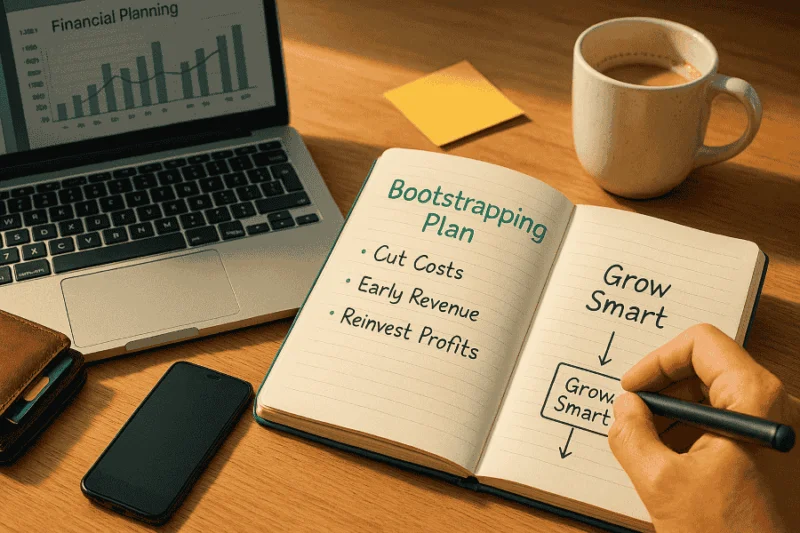
Bootstrapping is not a hobby. It is not a side project you tinker with on weekends. A bootstrapped startup is a real business that happens to be funded by customers instead of investors.
Read Also: Free Grants for Women Entrepreneurs in California Today
You keep full ownership. You make every call. You also carry every risk. The numbers tell you why most founders end up here. Roughly 78% of small business owners use their own funds to start.
Only a tiny fraction ever raise venture capital. Bootstrapping is not the exception. It is the default. What it does not mean is that you have no resources. It means your resources are constrained, and every rupee has to earn its place. The founders who succeed treat that constraint as a creative advantage, not a punishment.
The biggest mistake I made was building a product before confirming anyone would pay for it. I spent three months on features nobody asked for. Then I spent two weeks finding customers. The order should have been reversed.
The founders who bootstrap well talk to people first. They have actual conversations, not survey links . They find the sentence a potential customer says that makes them rethink the whole idea. If nobody says that sentence in the first fifteen conversations, they are talking to the wrong people.
Then they sell something ugly that solves a real problem. Not polished. Not perfect. Just useful enough that someone opens their wallet. That first payment validates more than any business plan ever will.
One founder I spoke to sold consulting sessions before building a platform. He delivered the service manually, behind the scenes, while collecting feedback. Six months later, he had a product roadmap built entirely from paying customers' complaints .

Every early-stage founder wants to be everywhere at once. Paid ads. Content. Partnerships. Community. Referrals. In year one, that is a recipe for doing five things badly.
You Must Also Like: 2026 Visa Bulletin EB-3 Advancement for Entrepreneurs
Pick one channel you can win with zero budget. Usually that means founder-led content or direct outreach . Go deep. Stay bored of it for six months.
The founders who win early are rarely the best marketers. They are the ones who picked one lane and refused to switch when it got tedious.
I spent my first year writing weekly posts in a niche forum. No ads. No SEO tricks. Just answers to questions people were already asking. It brought in more customers than the 15,000 I wasted on a Facebook campaign that targeted everyone and reached no one.
Undercharging is the bootstrapper's trap. You lower prices to get your first customers. Then you over-deliver to keep them. Then you realize you are working twice as hard for half the margin.
Price for value from day one. That might mean offering tiered options. It might mean setting a project minimum. It might mean walking away from a client who wants champagne on a beer budget. Every hour and every rupee has to count when you are funding growth yourself.
The footwear brand Larroudé launched with $4,000 and a Shopify site. They did not compete on price. They competed on design and direct-to-consumer relationships.
Within five years, they hit nine-digit revenue without outside funding. They proved that bootstrapping does not mean cheap. It means intentional.
No hire should happen until a founder has done that job themselves and hit a wall . If you have not felt the pain of doing sales, support, or operations, you do not know what you are hiring for.
The first five people shape your culture more than any values document. Bootstrapped founders often try to save money by compromising on team quality. That is a mistake. A bad hire costs more than a good hire's salary. It costs time, momentum, and sometimes customers.
Use freelancers and contractors for specific tasks. Bring on full-time people only when the work is consistent and the revenue supports it. Your team should grow because the business demands it, not because you want to feel like a real company.
Bootstrapping gives you control. It also gives you stress. Your personal savings are on the line. Growth is slower. You will wear every hat, including the ones you hate.
The five-year survival rate for bootstrapped founders is actually triple that of venture-backed ones. They also reach profitability faster, around eighteen months versus four-plus years.
The slowness is the point. You build something that can stand on its own before you try to make it run.
But there are limits. If your business needs expensive equipment or heavy inventory, bootstrapping may not be realistic. If a competitor with deep pockets can copy your model and outspend you, slow growth becomes a liability. Know which game you are playing.
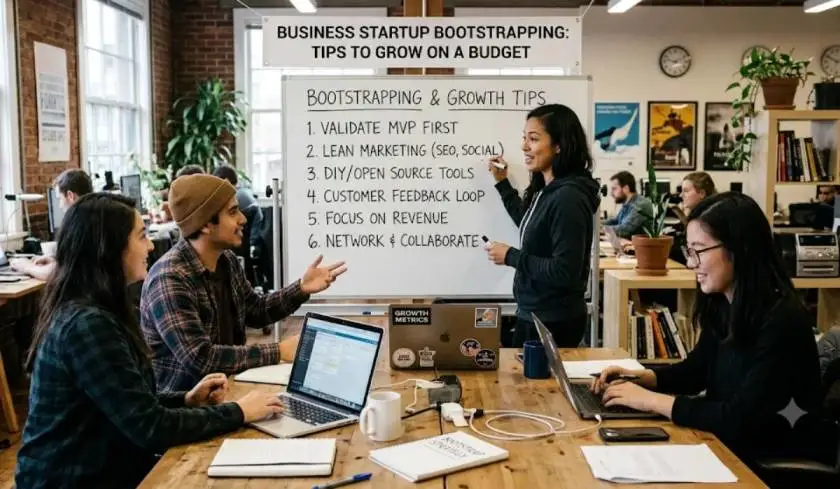
Do not write a business plan longer than one page. Talk to ten people who have the problem you want to solve. Sell something before you build it. Pick one marketing channel and ignore the rest.
Charge enough to cover your costs and your time. Hire nobody until you have done the job yourself.
The bootstrapping meaning in business is not about being cheap. It is about being deliberate. Every rupee you spend is a bet on your own judgment. Every customer who pays you is proof that the bet was worth making. That is the whole game.