
I spent a decade working alongside communities that the development programs were supposed to help. I watched microfinance clients start businesses that fed their children. I also watched debt repayments strip those same children of healthcare. The projects looked successful on paper. The evaluators flew home happy. But the families kept struggling.
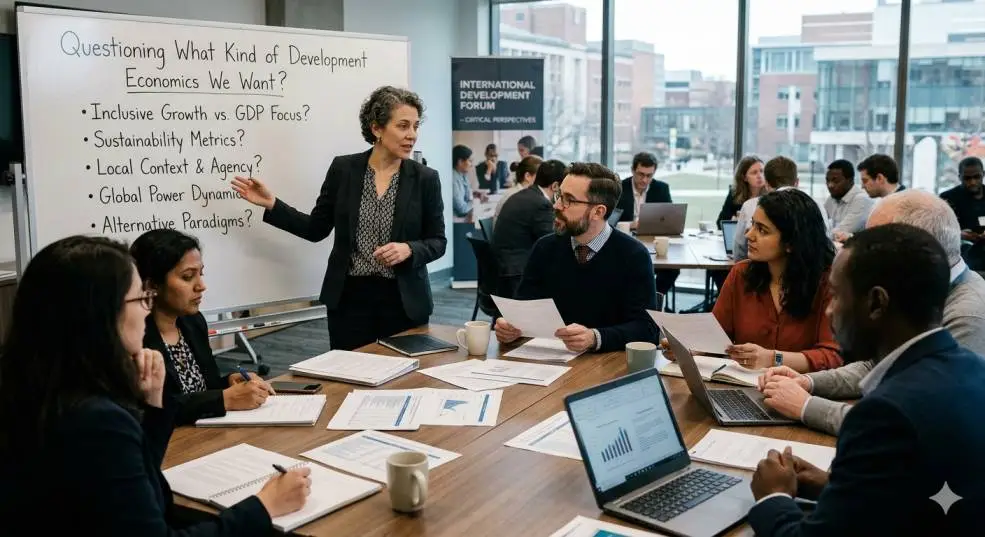
That experience forced me into a different kind of questioning. Not "how do we make development work better?" but "what do we actually mean by development?" And more urgently: questioning what kind of development economics we want for the next generation.
This is not an abstract debate happening in university seminars. It is a practical fight over who gets to define progress. Whose lives count in national accounts. Which sacrifices we call "necessary adjustments."
Let me walk you through what I have learned about this fight. No jargon. No academic detachment. Honest observations from someone who has seen both the promise and the failure up close.
I used to believe development followed a clear path. Poor countries lacked capital, technology, and institutions. Give them those things and they would catch up. Simple.
Related Article: The Most Valuable Lincoln Wheat Penny Rare Coins to Look For
I saw a government cut its education budget to meet credit rating agencies. The teachers kept showing up. The classrooms had fewer books. Fewer desks. Fewer meals for children who relied on school feeding programs. The country's credit rating improved. Its children did not.
This is the contradiction eating at development from the inside. Countries follow the rules. They liberalize markets. They stabilize currencies. They privatize state enterprises. And still, poverty persists. Inequality widens. Environmental systems collapse.
The nature of development economics has always involved trade-offs. But the old frameworks pretended those trade-offs were technical rather than moral. Invest in infrastructure or education? Support industry or agriculture? Open markets or protect local producers? These are not equations with right answers. They are value judgments with winners and losers.
Something happened recently that captured this shift in thinking. Regular people organized a spending boycott. There was no political party behind it. No corporate sponsorship. Citizens using their wallets as weapons.
The Feb 28 protest called for Americans to stop shopping at big retailers for 24 hours. No Amazon. No Walmart. No fast food. No gas stations. Local businesses should be used only when necessary.
A DC business owner named Rahama Wright closed her shop that day in solidarity. She put it simply: This moment is for us to pause and reflect and change the way that we operate. Her message was not about prices.
It was about power. Companies were rolling back diversity initiatives. Mass federal layoffs were happening. The blackout said: we notice. We have power too. In Bangor, Maine, a bookstore owner named Gibran Graham participated for different reasons. "Your small local businesses support your community," he said. "You don't see that from a lot of large national corporations.
A customer there named Ross Ludders captured the philosophy: Every dollar is a vote. When we think about the type of development economics we need, movements like this matter.
They represent ordinary people recognizing their collective weight. Development does not happen through ministries and aid agencies. It happens through millions of daily choices. These choices decide where money goes and who benefits.
The field of development economics has expanded well beyond what textbooks showed twenty years ago. In a 2010 book, Michael Tribe and his team outlined key areas:
Economic growth
Structural change
International trade
Poverty measurement
Useful stuff. But incomplete.
Today, the scope of development economics must include:
Climate adaptation occurs when seasons no longer follow patterns that farmers recognize.
Debt sustainability when repayment squeezes healthcare budgets
Care economy valuation when women's unpaid work remains invisible.
Natural capital accounting when forests are worth more dead than alive.
Digital infrastructure, when connectivity determines opportunities.
Robert Zoellick, the World Bank's head, said development economics should broaden its focus. Become more relevant to complex, multi-faceted problems. He highlighted four key areas to focus on:
Economic transformation
Inclusive and sustainable development
Managing risk and vulnerability
Analyzing what really works.
The scope of development economics is not expanding because academics want more publications. It is expanding because reality demands it. The old questions missed too much.
Check out groups like the economic coordination committee to see how they make development decisions. In Pakistan, this committee handles urgent economic matters. It includes ministers for:
Finance
Investment
Commerce
Economic affairs
Food security
Petroleum
Power
Planning
Eight ministers and eighteen co-opted members make up the group. This includes the State Bank governor and secretaries from all economic ministries. The economic coordination committee, which monitors monetary conditions. Stabilizes prices. Reviews trade policy. Evaluates industrial and agricultural growth. Handles oil exploration agreements. Oversees tariff issues.
In 2024, Pakistan's prime minister started chairing these meetings himself, signaling their importance.
Why does this matter for questioning what kind of development economics we want? Because decisions do not emerge from abstract forces. They come from specific people in specific rooms. Who sits at that table? What data do they see? Whose interests do they focus on? That is where development becomes real.
Scholars have long split development economics between macro and micro approaches. Macro people study growth, trade, and fiscal policy. Micro people study education, health, and microfinance. They spoke to each other only a little.
That is changing. Economist Dani Rodrik argues we can now envision a reunification. Microeconomists have become more interested in policy. Their experimental approaches mesh with macro trends on the ground.
The emerging consensus is not about specific policies. It is about how to do development policy at all. Both camps now recognize that we cannot know in advance what works. Context matters too much. The answer isn't in the Washington Consensus or any specific health or education programs.
Instead, development becomes experimental. Diagnostic. Evaluative. Pragmatic. If something works, do it. If it fails, try something else.
This shift represents real progress. But it also creates tension. The "randomistas" who conduct randomized trials often view their results as the only solid proof. That leaves macroeconomists looking like they deal in soft speculation. The methodological divide threatens to overshadow the policy convergence.
In early 2026, top economists gathered at UN Geneva to push for radical change. Their target: GDP. UN Secretary-General António Guterres put it bluntly. Global policymaking relies too heavily on GDP data. We see the daily effects of not balancing economic, social, and environmental development.
The "Beyond GDP" initiative argues that GDP overvalues activities that deplete the planet. It undervalues activities that sustain life and well-being. Nobel laureates are now developing actual indicators. A dashboard governments can actually use.
The importance of development economics shows up in what we choose to measure. If we only count market transactions, we miss everything that keeps societies functioning. Care work. Clean air. Social trust. Ecosystem health.
When someone cuts down a forest, GDP rises. When pollution occurs in a river, GDP rises. When a caregiver stays home with a sick child instead of working for wages, GDP falls. The numbers lie. Development economics that cannot see these things are not incomplete. It is dangerous.
The University of Melbourne's graduate course in development economics covers several core areas. Economic growth theory. Poverty and inequality measurement. Labor and credit market efficiency. Consumption smoothing. Microcredit schemes. Demographics.
Students learn to check how developing countries differ from developed ones. To analyze how those differences affect household decisions. To test theories against real-world data. To critique policy prescriptions.
The University of Kerbala's business school offers a similar breakdown. Poverty and inequality. Economic growth and structural development. Institutional and cultural factors. International trade and foreign aid. Human development beyond GDP.
Both programs emphasize that development economics connects theory to practical reality. It provides tools for understanding complex challenges. It offers a scientific basis for policy design.
But the textbooks cannot capture everything. The nature of development economics involves judgment. Experience. Humility about what we do not know.
Several concrete changes could shift development economics toward people and the planet.
Much of today's debt is short-term and procyclical. Private creditors now hold 57% of sub-Saharan Africa's external debt, up from 22% in 2000. This debt costs more. It is harder to restructure.
You Must Also Like: What Is the Difference Between Economy and Premium Economy?
It squeezes public budgets harder. What countries need instead is patient, long-term financing. Money that supports productive capacity. Climate resilience. Inclusive growth.
Some proposals include climate-resilient debt clauses that pause payments during disasters. Barbados introduced such a clause in 2022. The Debt Pause Clause Alliance pushes for broader adoption.
Creditors coordinate through formal clubs. Borrowers usually negotiate independently. This imbalance entrenches power disparities.
Establishing borrower clubs could strengthen collective bargaining. Improve transparency. Share intelligence. Set common thresholds to protect social infrastructure.
Current debt sustainability frameworks judge countries by their repayment capacity. They overlook critical financing needs for sustainable development.
Reformers want frameworks that distinguish liquidity from solvency. Account for domestic and external debt. Reflect public assets and long-run returns from growth-enhancing investments.
Academic research on development policies reveals uncomfortable truths. Even when political will exists for developmental policies, economic structures can block them. Rent-based economies create damaging incentives.
Policy externalization via international financial institutions erodes legitimacy. Both weaken accountability between leaders and citizens. Comparing Russia and sub-Saharan Africa shows this clearly.
Asian developmental states thrived for two reasons. They had clear national economic goals. They also industrialized successfully. These conditions weren't met in African states or Russia, but for different reasons.
The lesson: questioning what kind of development economics we want requires looking at actual outcomes. Not policies adopted. But structures that enabled or prevented success. Not intentions. But incentives that shaped behavior.
If you are trying to make sense of development today, here are some questions worth asking.
Who defines progress?
Is it finance ministers meeting creditors? Or communities deciding what they need? The Economic Coordination Committee makes high-level decisions. But whose voices reach that room?
What gets counted?
If unpaid care work stays invisible, policy will ignore it. If natural capital decline stays unmeasured, economies will appear healthier than they are.
What is the time horizon?
Short-term budget balance matters less than long-term productive investment. Fiscal space is not fixed. It can expand through investments that enhance social and environmental sustainability.
Who holds the debt?
Not how much countries owe. But who they owe. On what terms. Financing what.
What is being protected?
Schools. Health systems. Care for children, older people, and those with disabilities. These are not consumption. They are investments with economic and financial returns.
What is being depleted?
Clean air. Clean water. Fertile soils. Productive fisheries. Dense forests. These are not extras. They are foundations.