

You have probably heard the term "gig economy" tossed around in news headlines and casual conversation. Maybe you have even used a ride-sharing app or ordered food delivery without thinking twice.
But when you stop and ask yourself what is a gig economy, the answer is more complex than you might expect. It represents a fundamental shift in how work gets done. It is a system where short-term contracts and freelance work are becoming the norm, replacing the traditional 9-to-5 job for millions of people worldwide .
This guide cuts through the buzzwords. I want to show you what the gig economy actually looks like from the ground up, breaking down the gig economy definition, the gig economy advantages and disadvantages, and what the latest gig economy news means for you.
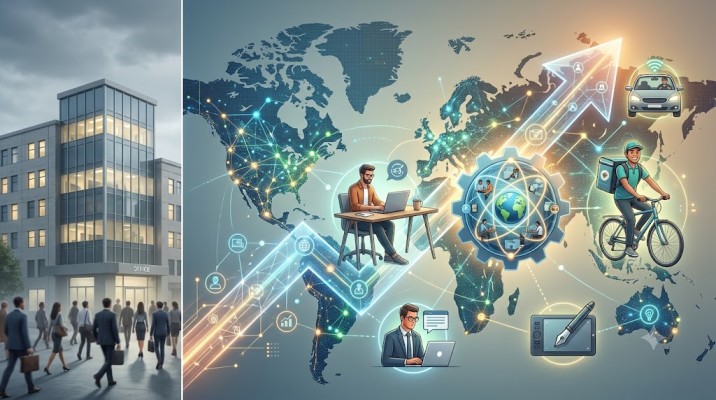
At its core, the gig economy definition is straightforward: it is a labour market built around short-term, flexible jobs, often facilitated by digital platforms that connect workers with clients.
Read Also: How Agentic AI Is Restructuring the Modern Workforce Today?
Think of it as the opposite of the traditional model where you get hired by one company, go to the same office every day, and receive a steady paycheck.
In this new model, work is broken down into "gigs." A gig could be a ride from Uber, a meal delivered by DoorDash, a logo designed on Fiverr, or a short data entry task on Amazon Mechanical Turk.
It is paid "per task" rather than with a regular salary and does not include benefits like health insurance or paid leave . What is a gig economy and how does it work in practice? Technology is the engine. Smartphone apps and websites act as intermediaries, instantly matching the supply of workers with the demand for services .
This is not a niche trend. The gig economy is massive and growing. Globally, it is projected to reach 1.5 billion workers . To put that in perspective, in China alone, the number of "flexible workers"those without permanent full-time contracts is expected to hit 320 million in 2026. That is a staggering 44% of the country's urban workforce .
In the UK, an estimated 1.7 million people work in the gig economy . In South Asia, India has around 24 million gig workers, and Bangladesh has over 600,000. This level of growth shows that the gig economy is not going anywhere. It is becoming a permanent feature of the global economic landscape.
To understand the gig economy advantages and disadvantages, you need to understand the different types of gig work. Generally, it falls into two broad categories:
Location-Based Gig Work: This involves physical services you do in a specific place. Ride-sharing drivers (Uber, Grab), food delivery riders (Deliveroo, Zomato), and home service providers (like cleaners or furniture assemblers on TaskRabbit) are the most visible examples. These gigs often use your own vehicle or tools .
Online Gig Work: This is work you can do entirely online, from anywhere in the world. It includes freelancing on platforms like Upwork and Fiverr for tasks like graphic design, writing, or software development. It also includes "crowd work" on platforms like Amazon Mechanical Turk, where you complete small, repetitive tasks for small payments .

The rise of the gig economy did not happen by accident. Several factors have converged to make it a powerful force in the job market.
You Must Also Like: What Is the Difference Between Economy and Premium Economy?
For Workers:
The main draw is flexibility. People are drawn to the idea of setting their own hours, working from home or any location, and having control over their schedule. This is especially appealing to parents, students, or anyone trying to balance work with other life commitments.
A Pew Research study found that nearly 40% of Gen Z workers engage in gig work, valuing freedom and purpose over the traditional work structure . For many, it provides a way to earn extra income through a side hustle, effectively creating a "work-life balance on their own terms."
For Businesses:
The advantages for companies are compelling too. It allows for massive cost-effectiveness; businesses only pay for the work that is done, avoiding the overhead of full-time salaries, benefits, and office space. It also provides scalability.
A company can quickly hire a team of freelancers for a specific project and let them go when the project is finished. This is incredibly useful for managing seasonal peaks or short-term initiatives .
It also gives them access to a global talent pool, allowing them to find the perfect person for a niche job, regardless of where they live .
This is where things get real. For every advantage, there is a significant drawback that can make life incredibly stressful.
Flexibility: You control your schedule. You choose when, where, and how much you work .
Independence: You are your own boss. No one micromanages your day. You have the freedom to decide which jobs to accept .
Variety: Your workdays can be different and challenging. You can work on diverse projects that keep you engaged .
Earning Potential: Theoretically, your earning potential is uncapped. You can take on more work to earn more money .
No Job Security: There are no long-term guarantees. Your income can be unpredictable and vary wildly from month to month . One week you are busy, the next you are struggling to find work.
No Benefits: This is a critical downside. Gig workers generally do not receive health insurance, retirement plans, or paid leave . You are entirely on your own to fund your healthcare and plan for retirement.
Unstable Income: The "feast or famine" cycle is a real problem. This irregular income makes budgeting and financial planning very difficult .
Legal and Tax Complexity: Since you are an independent contractor, you are responsible for your own taxes. The IRS requires you to pay estimated taxes quarterly, which can be complex and financially challenging, especially since you also have to pay the self-employment tax .
Isolation: Working alone, often in your home or a car, can be lonely. You miss out on the social interaction and community of a traditional workplace .
Algorithmic Control: In many gig apps, you are managed by an algorithm. It decides which jobs you get offered, and you have little to no recourse if you are unfairly penalized or deactivated by low ratings .
The precariousness of gig work has not gone unnoticed. Recent gig economy news shows a global push to protect workers. The debate over whether gig workers should be classified as "employees" or "independent contractors" is at the heart of it.
In the US, California famously adopted Assembly Bill No. 5, which uses an "ABC" test to classify many platform workers as employees, granting them access to benefits and protections .
In China, the government is stepping in. Trade unions are planning to recruit at least 7.5 million gig workers over the next five years. The goal is to push platform companies into collective bargaining over pay, algorithms, and working conditions. They are even targeting agreements for things like how orders are assigned and how performance is assessed .
Meanwhile, in the UK, major retailers like Lush and Uniqlo have stopped using gig economy apps over concerns about workers' rights . These actions show that while the gig economy is here to stay, there is a growing recognition that it needs to operate more fairly.
Whether you are considering a gig job to make ends meet or supplement your income, or you are a business owner looking to hire, you need to go into it with your eyes wide open.
The gig economy advantages and disadvantages paint a clear picture: it offers freedom and flexibility at the cost of security and stability. For workers, it is a trade-off. You get to be your own boss, but you also become solely responsible for your own safety net.
It is not a "welfare" system, as one professor controversially argued, but rather a difficult choice driven by a lack of better options for many . The future of work is being reshaped by the gig economy, but the fight to make it a sustainable and fair way to make a living is just beginning.